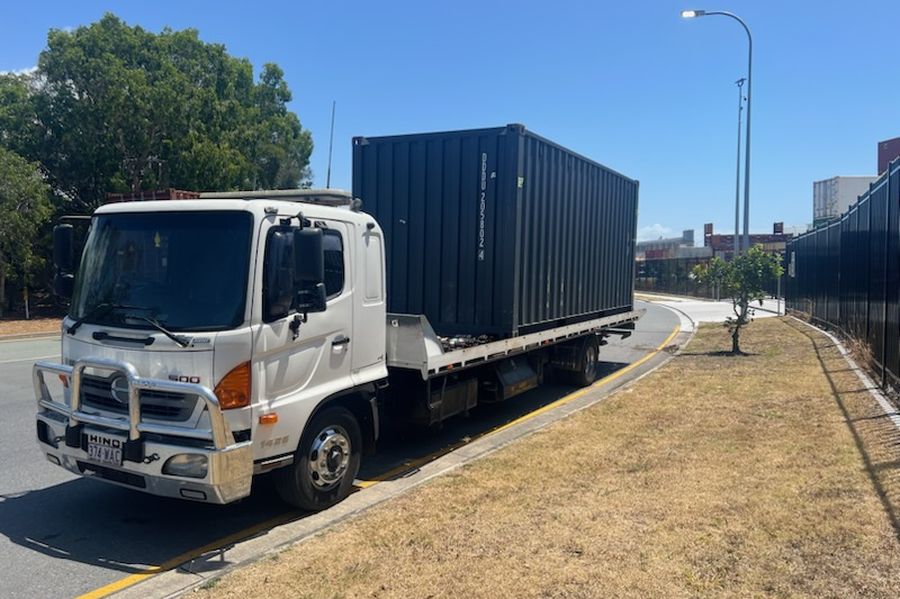
The short answer. Most 20ft containers loaded up to 10 tonnes travel on a tilt tray. Heavier 20ft containers and 40ft moves are done by side loader. A crane truck is booked when the site calls for it, and interstate moves usually run by rail with a truck at each end. We pick the truck for your job, and the price includes it.
Shipping containers are moved by container trucks, not towed. This guide covers the trucks that move them, what each one is used for, and how we choose. The right truck depends on the container, what is in it and what the site looks like.
Tilt tray
A tilt tray, also called a tilt slide, is the everyday container truck. The tray tilts and the container slides off the back onto the ground, then the truck drives out from under it. We use it for 20ft containers up to 10 tonnes loaded, which covers an empty box, a packed household and most site gear.
What the site needs: firm, level ground where the container will sit, clear overhead, and a straight run of about 15 to 20 metres for the truck to slide the container off and pull away. The container lands in line with the truck, so think about which way the doors should face before the day.
Side loader
A side loader, also called a swing lift, carries the container on a trailer with its own pair of cranes and lifts it on and off itself. Heavier 20ft containers and 40ft moves are done by side loader. If either site is tight, send us a photo and we will check it with the operator before we book.
Crane truck
A crane truck lifts the container with a crane mounted on the truck and places it where you want it. We book one when the site calls for it, and the quote says so up front.
Rail for interstate moves
Brisbane to Sydney and Brisbane to Melbourne usually run by rail. Rail is the reliable way to move a container on those lanes and keeps the price sharp. A truck collects the container, delivers it to the terminal, and another truck delivers it from the terminal at the other end. For rail the container needs a current CSC plate, and a loaded container needs its doors padlocked or sealed with the contents secured. We check the plate from a quick photo before we book.
How we choose the truck
Three things decide it: the container size, the loaded weight, and the site. Tell us what is going in the container and send a photo of where it is going, and we will confirm the truck with the operator before we book. The calculator prices 20ft and 40ft moves by weight band, so a tilt tray or side loader is built into the estimate you see.
What to check at your site
- Measure the straight run from the street or gate to where the container will sit.
- Look up: power lines, branches and eaves along the run and above the landing spot.
- Check the ground. Firm and level is what every truck needs, and soft or sloping ground is worth a photo.
- Gates and driveways: width, any tight turn, and whether a truck can get in and out without reversing a long way.
- Decide which way the doors should face.
If either site is tight on any of that, let us know and we will work out the best approach before the day rather than finding out on arrival.
What it costs
The tilt tray or side loader is built into the estimate, and a crane truck is priced for the job and shown in your confirmed rate. Indicative prices for 20ft and 40ft moves are in our cost to move a shipping container guide. Your estimate takes about two minutes in our calculator, and a confirmed price follows within one business day. Prefer to talk? Call 0423 859 829, 7am to 4pm weekdays.
The right truck, built into the price
Instant estimate online for a 20ft or 40ft, anywhere in Australia. We confirm the truck for your job before we book.